
Table of Contents
- Why Peptide Supply Chain Risks Have Changed in 2026
- TGA Peptide Import Regulations: What You Can and Cannot Bring In
- Peptide Purity Testing Standards: Reading a COA That Actually Holds Up
- Cold Chain Logistics for Research Chemicals: Temperature Control from Door to Bench
- Supplier Audit Checklist: Qualifying a Vendor Before You Order
- What You’ll Need
- Step 1: Verify Manufacturing Standards [Time: 10 minutes]
- Step 2: Check Third-Party Testing [Time: 10 minutes]
- Step 3: Review Cold Chain Handling [Time: 10 minutes]
- Step 4: Confirm Lot Traceability [Time: 10 minutes]
- Step 5: Test the Support Response [Time: 5 minutes]
- Counterfeit Detection and Provenance in the Peptide Supply Chain
- Post-Market Surveillance and What to Do When a Batch Fails
- Frequently Asked Questions
Last Updated: September 21, 2026
Why Peptide Supply Chain Risks Have Changed in 2026
Managing peptide supply chain risks is no longer just a procurement problem. It is now a scientific one. A peptide that arrives late is an inconvenience. A peptide that arrives degraded, mislabelled, or contaminated can quietly ruin months of assay work before anyone notices.
Three forces drive the change:
- Global manufacturing capacity is stretched, so lead times stretch too
- Regulatory scrutiny of unapproved products has tightened
- Cold chain failures are harder to detect without proper logging
This guide walks through the practical controls that keep a peptide supply chain intact, from import rules to batch failure response. Below, we break down each layer so you can build a procurement strategy that holds up under audit.
TGA Peptide Import Regulations: What You Can and Cannot Bring In
The Therapeutic Goods Administration (TGA) regulates what can legally enter the country as a therapeutic good.
A few practical points:
- Check the TGA guidance on unapproved therapeutic goods before you order
- Confirm whether your institution holds the right licence or exemption
- Keep import records for every shipment, not just the expensive ones
Ordering an unapproved peptide without the correct exemption is a regulatory breach, not a paperwork slip. It can trigger seizure at the border and put your institution’s import privileges at risk.
The practical rule: know the product’s status before it ships, not after it lands.
Peptide Purity Testing Standards: Reading a COA That Actually Holds Up
A Certificate of Analysis is only as good as the lab behind it. Peptide purity testing standards rely on two core methods: HPLC for purity percentage and mass spectrometry for identity confirmation.
| COA Element | What Good Looks Like | Red Flag |
|---|---|---|
| HPLC trace | Full chromatogram, not just a number | A purity figure with no trace |
| Mass spec | Confirmed molecular weight | Missing or blank |
| Lot number | Matches your vial | No lot reference |
| Testing lab | Named, third-party | “In-house” only |
| Date | Recent, batch-specific | Old or generic |
Ask whether the testing lab is independent of the manufacturer. A COA from the same facility that made the peptide is a quality assurance claim, not third-party verification.
Cold Chain Logistics for Research Chemicals: Temperature Control from Door to Bench
Cold chain logistics for research chemicals is the part most buyers underestimate. Peptides are temperature-sensitive, and stability testing shows they degrade when shipping conditions drift outside their range. The failure is usually silent: a vial that thawed in transit and refroze may pass a visual check and still fail in your assay.
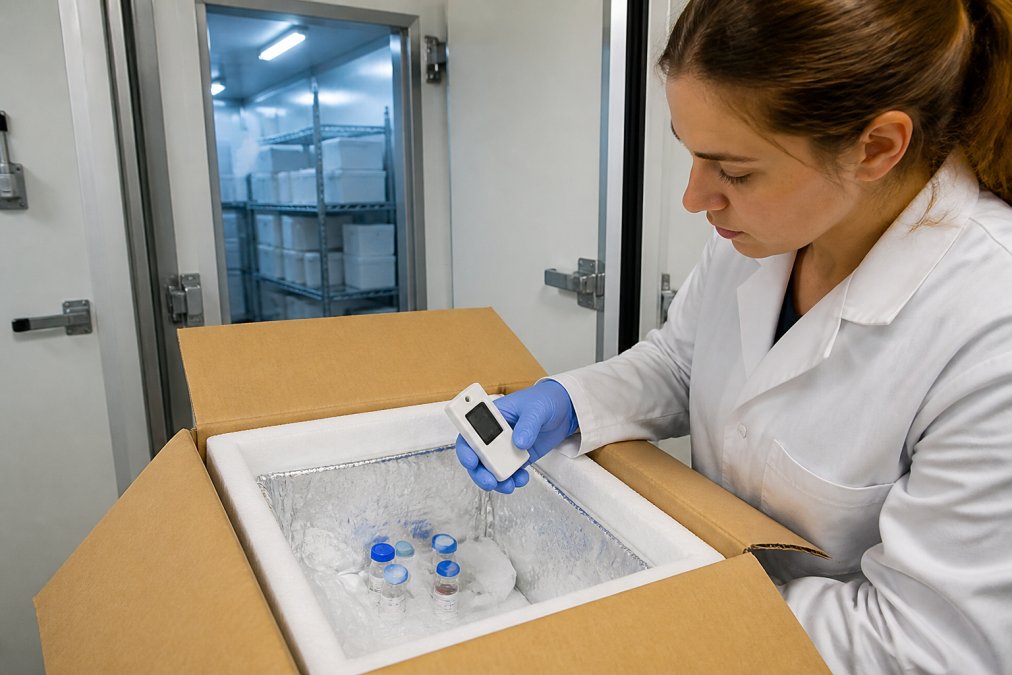
Stage 1, Packing and configuration
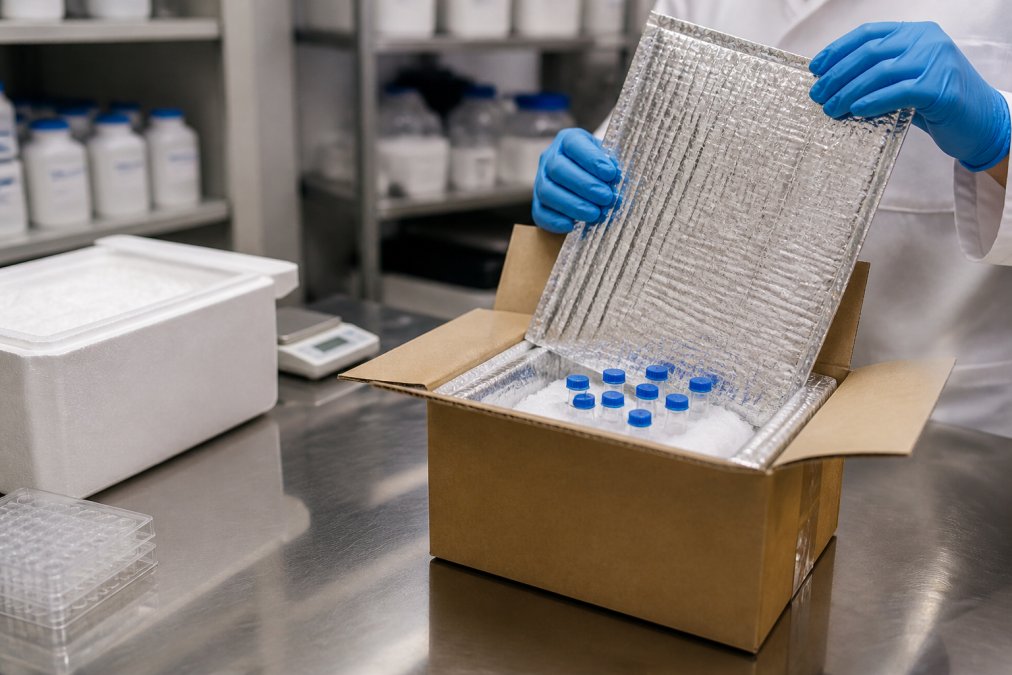
Most lyophilised peptides ship at ambient or 2-8 °C; reconstituted or solution-phase peptides typically need 2-8 °C or frozen conditions depending on the sequence. The packing configuration should match the product, not the courier’s default:
- Insulated shipper (EPS or polyurethane) sized to the payload, not oversized
- Phase-change refrigerant (gel packs for 2-8 °C, dry ice for frozen) conditioned before loading
- A calibrated data logger placed with the vials, not taped to the lid
- A secondary barrier (sealed bag) so condensation cannot reach the label or COA
Stage 2, Transit and excursion windows
A temperature excursion is any deviation outside the labelled range. What matters is the magnitude and duration, not just that it happened. A 30-minute spike to 12 °C during a 2-8 °C shipment is a different event from a 12-hour hold at 25 °C. Ask your supplier for the excursion definition they work to, and check it against your own stability data.
Stage 3, Receipt and acceptance
On arrival, before the box goes into the cold room:
- Photograph the logger display and the box seal
- Download the logger trace and archive it with the COA
- Compare the trace against the labelled range
- Quarantine any shipment with an unexplained excursion until the supplier responds
Stage 4, Storage and in-house handling
Once accepted, the risk shifts indoors. Aliquot on first thaw to avoid repeated freeze-thaw cycles, label each aliquot with the lot number and date, and keep a temperature log for the storage unit itself. A cold room that drifts overnight is a supply chain risk even though nothing shipped.
Supplier Audit Checklist: Qualifying a Vendor Before You Order
Vendor qualification is where risk mitigation actually starts. A supplier audit checklist turns a vague trust decision into a repeatable process.
Total Time: 45 minutes per new vendor
Difficulty: Beginner
What You’ll Need
- Vendor’s quality documentation
- Sample COA and HPLC trace
- Shipping and cold chain records
Step 1: Verify Manufacturing Standards [Time: 10 minutes]
Confirm the facility follows TGA-compliant manufacturing standards and can show documentation.
Expected Result: A named facility with auditable quality systems.
Step 2: Check Third-Party Testing [Time: 10 minutes]
Ask whether purity testing is independent.
Expected Result: A named external lab, not self-certification.
Step 3: Review Cold Chain Handling [Time: 10 minutes]
Request shipping logs and packaging specs.
Expected Result: Documented temperature control from dispatch to delivery.
Step 4: Confirm Lot Traceability [Time: 10 minutes]
Ask how lots are matched across repeat orders.
Expected Result: A clear lot-matching process for standing orders.
Step 5: Test the Support Response [Time: 5 minutes]
Send a technical question and time the reply.
Expected Result: A knowledgeable answer within a reasonable window.
Counterfeit Detection and Provenance in the Peptide Supply Chain
Counterfeit detection in pharmaceutical supply chains comes down to provenance. Provenance is the documented history of a product, from raw API sourcing through to the vial in your hand. Grey-market distribution breaks that chain. When a peptide passes through unverified resellers, the trail goes cold, and that is where contamination risks and mislabelled products enter.
Detection signals you can act on
Counterfeits rarely announce themselves. The practical signals cluster into four groups:
- Documentation: a COA with no lot number, a mass spec with no molecular weight, or a testing lab that cannot be named
- Physical: label fonts or vial caps that differ from previous orders of the same product, or a batch number that does not match the COA
- Commercial: a price materially below the market for that sequence, or a supplier who cannot explain the gap
- Behavioural: a vendor who resists lot-level questions, or who changes the answer between orders
A traceability framework you can run today
Blockchain for peptide traceability is emerging as one answer, and a shared, tamper-resistant ledger does let each handler record a transfer so the full path stays visible. It is not yet standard, and for most buyers the practical work sits one layer down: a documented chain of custody that survives an audit.
Build it in five fields per lot:
- API origin, country and, where disclosed, the manufacturer of the raw peptide
- Finishing site, the facility that filled and lyophilised the vials
- Testing lab, the named third party that ran HPLC and mass spec
- Transfer log, every handler between finishing and your bench, with dates
- Receipt record, your own arrival check, logger trace, and storage entry
Where blockchain fits, and where it does not
A distributed ledger is useful when multiple parties need to see the same transfer history without trusting a single record-keeper. It is not a substitute for physical testing, and it does not verify that the contents of a vial match the label. Treat it as a provenance layer on top of your COA and lot-matching process, not a replacement for either.
Post-market surveillance as a detection tool
Provenance is a chain, not a certificate. If you cannot fill in all five fields for a lot, you do not have traceability, you have a claim.
For now, practical steps work: buy from suppliers who can trace API sourcing, match lot numbers across every order, and treat unexplained price gaps as a warning sign.
Post-Market Surveillance and What to Do When a Batch Fails
Post-market surveillance is the step almost nobody plans for. It is the process of tracking product performance after delivery and acting when something goes wrong.
- Quarantine the batch and stop using it
- Record the failure with your test data
- Notify the supplier with the COA and your results
- Request replacement or refund under their stated policy
- Log the incident for your own vendor records
Frequently Asked Questions
What are the safety risks of using non-compliant peptides?
Non-compliant peptides carry contamination, incorrect sequence, and degraded product risks. Without independent purity testing and a verifiable certificate of analysis, you cannot confirm identity or purity. Adverse health effects in research settings usually trace back to endotoxins, residual solvents, or truncated sequences that a proper COA would flag. For in-vitro work, contaminated reagents invalidate results and waste months of lab time.
How does the TGA regulate the importation of research peptides?
The TGA regulates therapeutic goods under the Therapeutic Goods Act 1989. Research peptides intended for laboratory use only are generally not registered therapeutic goods, but importation still depends on scheduling under the Poisons Standard and any applicable import permit requirements. Some peptides are restricted or prohibited. Procurement teams should confirm the scheduling status of each peptide before ordering and keep documentation showing the intended research use.
How do cold chain logistics impact peptide integrity?
Peptides are temperature-sensitive. Most lyophilised peptides tolerate short ambient exposure, but reconstituted peptides degrade quickly outside 2-8 degrees Celsius. Repeated freeze-thaw cycles and uncontrolled shipping conditions cause aggregation and loss of activity. A cold chain with validated packaging, temperature loggers, and clear excursion protocols protects product integrity from dispatch to your freezer.
What documentation should accompany high-quality research peptides?
Expect a batch-specific certificate of analysis showing HPLC purity, mass spectrometry confirmation, and the testing method used. Look for the lot number matching your vial, storage instructions, and a safety data sheet. For procurement, ask for evidence of GMP-aligned manufacturing and third-party audit reports. If a supplier cannot produce lot-matched documentation on request, treat that as a vendor qualification failure.
Peptide supply chain risk is manageable, but only with the right controls in place. The labs that avoid trouble are the ones that verify purity with real data, log every shipment, and qualify vendors before ordering. PeppHub supports that work with research-grade peptides at a minimum 99% purity, TGA-compliant manufacturing, and lot-matched documentation you can hand straight to procurement. Get started with PeppHub and build a supply chain your assays can trust.


